
FutureBoards Cross Border Dialogue - Singapore, 2026
On 28 January 2026, FutureBoards together with the Royal Norwegian Embassy in Singapore, Telenor Asia, Singapore Institute of Directors (SID) and the Norwegian Business Association Singapore (NBAS) co-hosted the seventh Singapore edition FutureBoards Cross-Border Dialogue.
New realities for Board of Directors
Alongside geopolitical instability and the climate crisis, institutional investors and regulators, as well as a growing number of ‘other’ stakeholders such as employees, customers, suppliers and partners are increasingly expecting more from the companies. This has a number of implications for the composition of corporate boards as well as the individual board directors.
At the same time, generative AI is evolving rapidly, and companies need to balance pace and innovation with caution. The board’s role is to constructively challenge the leadership team to ensure this happens, while keeping the organization at the forefront of these latest technological developments, but at the same time being acutely aware of the risks. Ultimately, directors are responsible for how generative AI is used in an ethical way in the companies they oversee, and the answers they receive should help them fulfill this responsibility wisely.
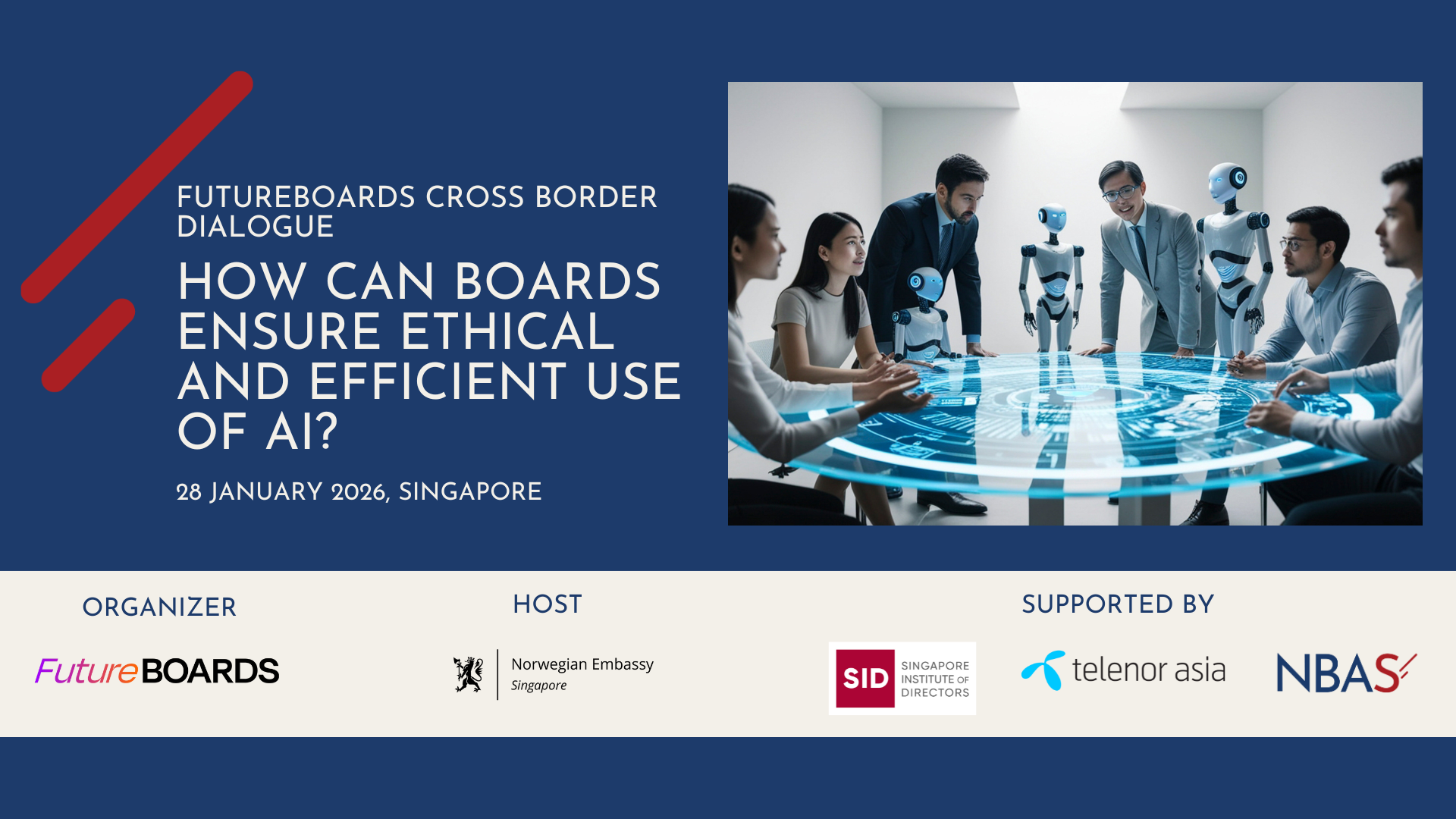
To explore this topic, FutureBoards together with the Royal Norwegian Embassy in Singapore, Telenor Asia, Singapore Institute of Directors (SID), and the Norwegian Business Association Singapore (NBAS) co-hosted the seventh Singapore version of FutureBoards Cross-Border Dialogue on “How boards can ensure ethical and efficient use of AI”.
On January 28 at Telenor Asia’s office, a new record of 100 registered participants, ranging from high-ranked board directors, executives, academics and practitioners, came together to discuss how boards may ensure the correct and accountable usage of AI. The importance and dominating factors of AI, humans’ role in the development and use of AI, as well as further innovation, are subject high on the agenda. The cross-border dialogue seeks to establish a forum to advance the agenda of gender (im)balance, accountability, security, and ethics in corporate governance, an essential component of leveraging AI as a reliable complementary tool.
Artificial Intelligence - opportunities and dilemmas in the corporate world
The topic of this year’s FutureBoards was seen as timely and highly relevant. AI is one of the most important issues of our time, and it is not on the table to not utilize the technology, even though regulations at a cross-border level might not be easy. The event kickstarted with a dialogue stressing how AI dominates our life and that governance needs to keep pace. A switch from “can do” to “should do” is reasonable, emphasizing the importance of human role as technology should circle around us and not the other way around. Therefore, innovation must enhance trust.
A key red line in the dialogue was emphasis on the importance of ethical use of AI but also the issues of unequal access to AI and how to include those people. The participants, some from major tech firms and financial institutions, reflected on different forms of regulations on AI, such as infrastructure, deployment, and AI-laws. Their key message was the importance of understanding both the role of AI and the technology itself through a collective approach, such as ongoing feedback and explanations.
AI in practice – leading from the boardroom?
The first panel, including speakers from a leading management consulting firm and one of the major hyperscaler explored approaches for accountable use of AI, emphasizing that it should be seen as a tool that occasionally fails at points. The panel further stresses that one should learn AI from others and elaborates on being aware of how to use AI for efficiency and in a responsible way. AI for the purpose of data analysis and cross-checking gets pointed out.
Board competence and composition in an AI context
The second panel discussed AI-governance and the importance of understanding why an organization is using AI. In that matter, responsibility, transparency, accountability, and awareness of biases are highlighted. The aspect of being too focused on tech rather than moral and ethics also gets pointed out, while arguing the significance of moral judgement by humans over mathematical conclusions by AI. However, the discussion also emphasizes that AI can complement boards in decision-making, even though there are different needs for AI for different businesses. Digital competencies get higher appreciation, and board members should deepen their knowledge for AI through courses, etc.
The panel sessions were complemented by an engaging round of plenary discussion where participants shared their perspectives, views, and experiences. One participant pointed out that the board members at the panel discussion seem more scared and pessimistic towards AI, rather than looking at it as a complimentary tool. Other stresses the awareness and “step-by-step” approach we should have in encountering AI.
Reflections – Where do we go from here?
Overall, the dialogue brought forth the importance of approaching AI critically while highlighting that AI is now becoming baseline competency. We should keep context clear and focus on what matters in the evolving landscape of AI.
A few questions for reflection:
Do we have the ethical compass positioned within our organisations value system to responsibly handle what happens next?"
AI literacy is now a baseline fiduciary duty. But it’s not just about knowing how the new large language models works—it’s about having the courage to ask, "Just because we can deploy this, should we?"
We need directors who are professional sceptics and realists—people who can look at an algorithmic recommendation and find the human blind spots. Is your nominating committee looking for ethical reasoning and systems thinking?
We are drowning in data but starving for wisdom. AI can give us infinite scenarios, but it can´t in all instances provide context. The board’s true competitive advantage isn't having access to the most information, it’s the ability to filter important signals from the noise. Is your board missing the nuance of how that data affects our organisation and our people?
The reality check
The oversight gap - do we actually know which AI systems are running and influence our "black box" decisions?
The "why" factor - are we asking "should we?" as often as "can we?"
The speed dial - are we moving fast enough to be relevant and slow enough to be responsible long term?
AI doesn’t care about national geographical borders and boundaries, which makes the FutureBoards Cross-Border Dialogue important. We can’t afford and risk a fragmented regulatory landscape globally, whether it's the UK, EU, Singapore or Norway, we need interoperability - no single board or country has the monopoly on "correct" AI ethics. We are all learning together as we are moving forward.
Huge and warm thanks to all who contributed to this important discussion!
Norway’s Ambassador to Singapore – H.E. Leif Trana
Manisha Dogra, SVP, Head of External Relations & Sustainability, Telenor ASIA
Turid Solvang, Founder/CEO FutureBoards
Vicky Bowman, Vicky Bowman, Independent Chair of the Global Network Initiative (GNI) and Senior Adviser at the Institute for Human Rights and Business (IHRB)
Durgesh Karanjkar, Senior Primary Research Analyst, Corporate Access and Research – Active Strategies, Norges Bank Investment Management
Jon Omund Revhaug, Executive Vice President and Head of Telenor Asia
Lorena Paglia, Global AI & Sustainability Transformation Leader I Board Director, Microsoft
Oliver Tonby, Senior Partner Emeritus, McKinsey & Company
Su-Yen Wong, Chairperson, James Cook University in Singapore, Independent Director - City Developments Ltd, CSE Global, First Resources
Ooi Huey Tyng, Board Member, Chair, Risk Management Committee. AIG AP Board, Maxis Berhad, Singapore Institute of Directors.
Federico Donato, MGPartners MFO Singapore, Managing Partner, Council Member, Singapore Business Federation
Ricky Foo, Partner and Board & CEO Practice APAC Lead at Mercuri Urval
Tone Dale, Secretary General Norwegian Business Association Singapore
Leonard Opitz Stornes, Partner and Managing Director Asia : QUARKS, President Norwegian Business Association Singapore (NBAS)